

A Simple Way to Start Using Keywords to Boost Traffic

If you’re a coach or solo professional who regularly writes articles, newsletters, or blog posts, THIS is a swift, smart move to improve your marketing.
And as you know, I love written content because when you do it well, it’s engaging and shows you know your stuff. It builds trust —> which quietly sells you.
So, if you’re already taking the time to write, you might as well make those articles work harder for you. An easy upgrade is to start incorporating a single keyword phrases into your content so search engines (and AI chatbots) will share your content.
This trick is a perfect step for SEO newbies.
Here’s how …
Step 1. Start With One Keyword Phrase
SEO is all about keywords — the actual words people use in Google or ChatGPT when solving a problem.
So, we begin with ONE RELEVANT PHRASE of 3 to 4 words related to your article and something people are highly likely to think or say.
Take Diana’s article as an example,
How to find calm in the whirlwind: Anchors for the Holidays.
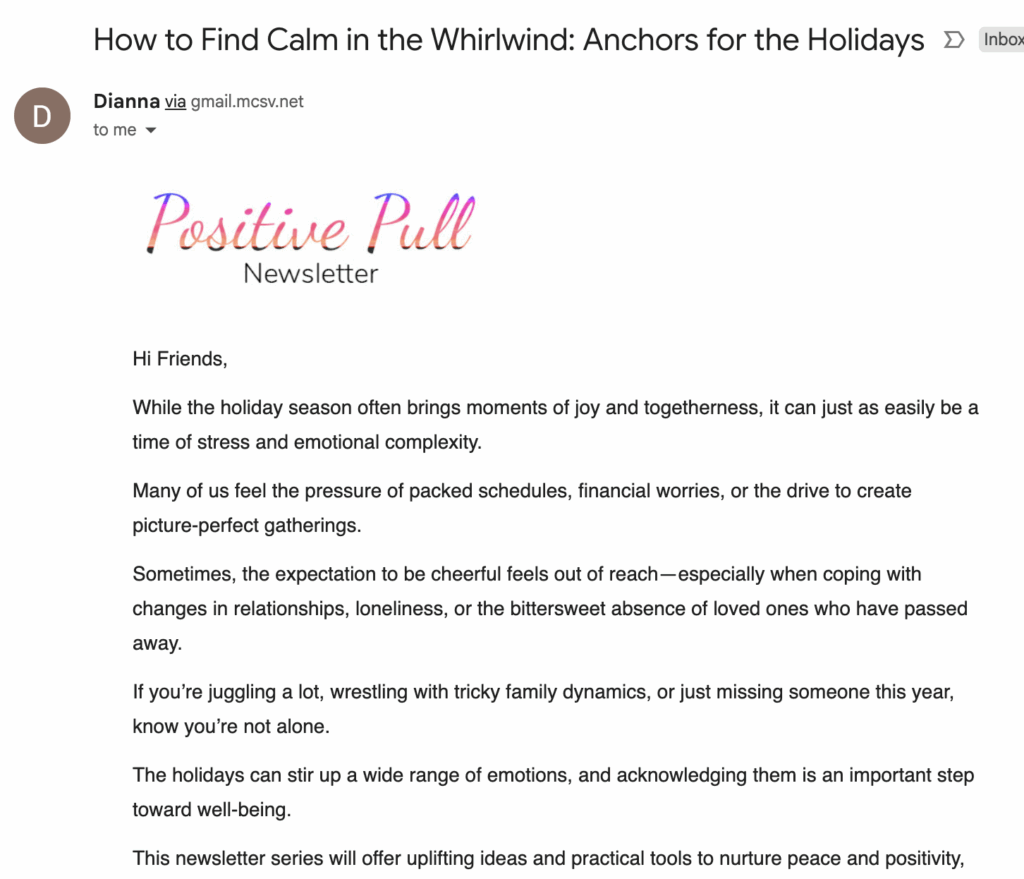
It’s a great title because it has mystery and value. But, I bet people aren’t searching for “find calm in the whirlwind” or “anchors for the holidays.”
Instead, they seek:
- how to deal with holiday stress
- holiday stress relief tips
- holiday overwhelm
- how to stay calm during the holidays
Those are the real phrases people would use when the problem is happening.
Step 2. Let ChatGPT Help
There are fancy SEO tools out there for keyword research to help find the best phrases. But quick research will find good answers you can use right now.
Here’s my prompt …
“What phrases do people use when they search for help with holiday overwhelm?”
Here’s what I got …
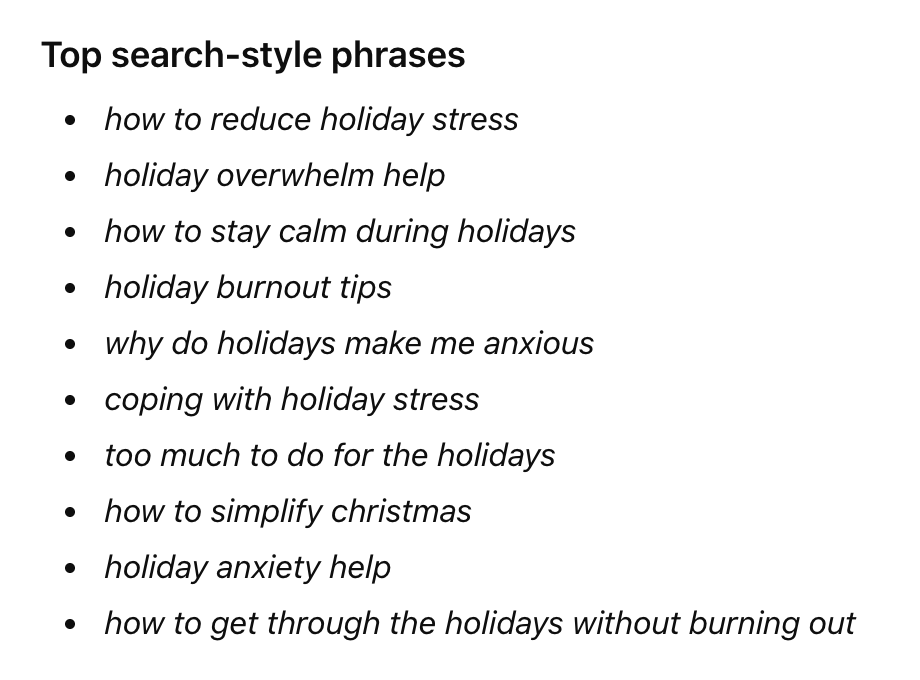
So, after reading Dianna’s article, and considering the phrases above, I’m thinknig “manage holiday overwhelm” or “holiday stress relief tips.”
Step 3. Put the keyword phrase into the title smoothly
Place the phrase at the front of the title. Search engines give more weight there since it’s most prominent.
If you think about emails, the subject line (a title) is cut short when viewing on a mobile phone.
So, our reworked title looks like this:
Manage Holiday Overwhelm — Finding Calm With Anchors
With this addition, search engines and AI agents can better relate your content to their users requests.
Step 4. Work It Into the Body
With a little word-smithing or AI prompting, get your phrase or similar versions of it into your content.
But warning! This is where things often get messy real fast, and your writing ends up clumsy. You want minimally invasive use, and ideally keyword to improve your content.
A simple start — aim to get the keywords:
- once near the top
- once somewhere in the middle
- once near the end
“Doable” grows your business.
Winning online means improving what you do consistently.
And if you’re regularly posting content (social, blog, newsletters, articles, etc.), which is great for legit visibility and credibility as a coach, then attending to your keywords is a savvy next step. Keyword phrases help algorithms (chats, AI, search engines) figure out what to share with folks who are seeking answers — ie potential followers, subscribers or clients.
Wuddya think? Comment below.
I love teaching, and hearing back from you brings me micro-joy. Thoughts, questions, ideas and brain farts — all welcome. Just post below.
This is very helpful and informative. I can see how this works, and will be implementing this method.
Thanks Kenn – Great tips — the single keyword phrase idea makes SEO feel much more doable. It also fits with how I work with clients to stay focused on what people genuinely need, which is how I try to write my own content too.
It definitely helps me when content comes from real struggles and needs. Thanks for pointing that out Gaye.
Food for thought! I like the systematic approach you describe and it’s definitely a skill I can develop and incorporate into my writing. Thanks!
Great! Yeah, an easy add.
Powerful post, Kenn! Anyone following this WILL get more visibility, more traffic from search engines. Priceless skill to learn.
And I agree with 96.72% of it.
I agree that placing keywords in the title, subtitle, url slug – and also helps somewhat if you place them in the text/article/blog post at the top, middle, and end is a solid starting point. It helps ensure consistency without falling into keyword stuffing.
At the same time, SEO is a living beast that keeps evolving. These days, search engines are super smart and care less about rigid placement rules and more about natural keyword usage across the page. In particular, they give extra weight to keywords in the first 100 words, headings, and title tags, since those areas signal relevance right away.
The real win is blending strategy with readability so your content feels authentic to humans while still being clear to algorithms.
Yeah, search engines, and AI searches ultimately want relevance.
This is a big plus for coaches who tell real stories, with real help, on real problems.
Tech will better align things so people are happier — though there is that risk of overdosing on dopaminergic kind of content.
I wish, more than anything, that I had a SEO keyword that really matched what I do. No one searches for an offer strategist. I have to be lumped in with the millions of marketing or business strategists. Ugh 😩
Hugs. 🙂
I like “Offer Strategist” for reference.
BONUS TIP FOR EVERYONE: The other way, as Lori often does, is to create content on painful thoughts, like those that are around offering struggles. This is good because AI, which is mostly in conversational form, would share your name for your ramblings on these:
“People don’t really get what I do.”
“My offer feels too vague or too general.”
“I keep attracting the wrong clients.”
“I’m not sure how to package what I do.”
“I don’t know how to explain the value clearly.”
“I feel like I’m doing too many things.”
“I don’t know what to include in my offer.”
“My prices feel random—I don’t know how to justify them.”
“I can’t tell what makes my offer different from others.”
“I don’t know how to turn what I do into a clear program.”
It think it’s why LinkedIn has that massive expert questions thing.
Thank you for bringing key words & SEO into the practical realm. I’ve understood the concept for a bit but didn’t know how to execute. I’m going to change my title in this blog & review how I’ve done for the next one before sending it out tomorrow.
Great … also could help if you the keywors into the URL (link) as well.
In WordPress, it’s called a “slug.”
Superb … small steps add up.
This is super helpful, Kenn. I am only just starting out with my new website and when I post an article I get SEO prompts but no real clue how to improve it. This post makes total sense. I’d search “How to improve SEO for idiots like me!” 🤣
Yeehaww! Love the “travel coaching” gig you got going.