

AI Referrals to your website

I’ve always been an SEO nut. It was the source of most of my clients in the beginning of my little web design business journey. I got lots of clients from Google, and SEO has been a big part of my business for years.
Over the last year, I’ve been using a lot more AI, and I’ve gotten a handful of AI referrals. I wouldn’t call myself an expert in AI referrals, but a lot of this overlaps with SEO, content that puts clients first, and general good marketing practices.
In this article, I’m sharing ten ways to improve your website for AI search, with my comments and quick tips on how to think about each one and apply it to your content.
1. Check that search systems can access your site
You need to check if your website hosting services, the firewall, and all the technology behind it are allowing AI crawlers to access your website and content. These crawlers identify themselves. Make sure there is nothing blocking them.
Yes, there’s a bit of a battle between authentic content and AI-driven content. Many platforms don’t like AI accessing information in ways that could circumvent their ability to keep users on the platform instead of simply chatting with AI. As a result, AI agents are sometimes unable to access content. You’ve probably seen this already in many good chats. When you build your website, you want to make sure it’s accessible to AI. You can even use AI to help check that.
More technical info
Ask your website person to check that your robots.txt file, security service, firewall and hosting setup are not accidentally blocking the search crawlers you want to allow. Google says a page must be indexed and eligible to appear in ordinary search before it can appear as a supporting link in its AI features.
ChatGPT has a separate crawler for search called OAI-SearchBot. OpenAI’s crawler guidance says you can allow that crawler while blocking GPTBot, which is used for possible model training. You do not have to allow training to be eligible for ChatGPT search results.
Also ask your website person to check that the important words on each page are available in the page’s initial code, rather than appearing only after JavaScript runs. A 2024 study of AI crawlers found that several did not execute JavaScript at that time. Crawler behaviour can change, but making the main content readable without scripts is still a sensible precaution.
2. Say clearly who you help and what you help them with
We’re all at different places in our coaching business—maybe more general, maybe in a tightly identified niche. Discussing WHO is currently an ideal fit can help AI match you with the conversations people are having.
The more detail you provide, the better. And if you have multiple, just choose one for now. Maybe you’re working locally, doing groups in person, or focused on parents whose kid is going to college or couples with childhood trauma. So talk as best you can about who you help and what you help them with.
As AI gets better, as people get more intimate with it, and as we get better and faster at reaching and connecting all over the world—and interplanetary with robots, ha ha ha—the cultural fit will only get better.
3. Answer the questions prospective clients really ask
For fun, go choose your favorite AI tool and chat with it. Ask it to imagine it’s one of your ideal clients—the struggles and challenges they have, what life is like for them, and what they’d be asking AI if they were chatting about those challenges.
Ask AI to come up with a handful of things they’d be asking or wondering about. If they were searching for support—a counselor, life coach, health coach, guide or mentor—what would they ask while researching that kind of help?
Then imagine yourself in that conversation. Ask those questions and see what AI comes up with.
And then boom—you’ve got your list of topics, questions, ideas and articles you could write, share and post to your website to help AI see when you’re a good fit to refer.
Try this prompt!
Copy and paste this into your AI tool:
Help me create 10 useful FAQ-style article ideas for my coaching website. Before suggesting any topics, ask me one short question at a time so you can understand my ideal client or client avatar: who they are, their current situation, the problems and frustrations they face, what they want instead, the language they use, and examples of past clients I especially enjoyed helping. If I describe more than one type of ideal client, help me choose one for this exercise. Do not create the ideas until I have answered your questions. Then give me 10 questions written in the natural words this person might type into Google or ask an AI tool. Make each question specific enough to become a useful website article, blog post, newsletter or social post. Avoid broad motivational topics. Under each question, add one sentence explaining what the article should help the reader understand or do.
4. Show your experience and give people reasons to trust you
Experience builds credibility. Give concrete examples of things you’ve done, even if you don’t like boasting about yourself. The thing is, your ideal clients and AI love to take in that real information when sharing you with potential clients.
Public reviews—like reviews of your Amazon book or local reviews on Google Maps—are valuable because they go beyond your self-promotion.
- One of my clients in New York doesn’t have the most reviews, but he has the highest star rating among his competitors, who may have hundreds more reviews. He still gets a lot of client referrals
- Another client of mine, a career coach in the UK, got client leads from her Google reviews and being present on Google Maps
One slick, trust-building, practical move – set up your local listing.
As coaches, we think we can coach anyone, anywhere, so we may not think to work on local search. But if your business qualifies, I believe a local Google listing is a good way to build trust and credibility in your area.
People don’t always need their coach to be local. But the more they can see that you’re a real, legitimate business, the more reasons they have to trust you.
Really, really, really, really, really good AI advice…
Generic advice is easy to reproduce. Your experience is what can make an article worth reading and referring to.
Explain what you have noticed in your work, how you approach a problem and why you recommend one option over another. Where confidentiality allows, include a real example from your own work, with identifying details removed, that helps the reader understand the point.
Be precise about the limits of the example. One client’s experience is not proof that everyone will get the same result.
Google’s local ranking guidance says review count and positive ratings can help a business’s local ranking, alongside relevance, distance and prominence. That is local-search guidance—not proof that reviews or higher star ratings cause AI referrals, or that the highest rating always matters more than review volume.
A Google Business Profile is not for every coach. Google’s eligibility guidance generally requires in-person contact with customers during stated hours, so an online-only coaching business does not qualify. If you do qualify, keep your reviews genuine and your business details accurate.
Make it clear who wrote the article too. Use a byline that links to an author page with your relevant background and qualifications. Google’s people-first content guidance encourages firsthand expertise, accurate authorship information and content that leaves the reader feeling they have learned enough to move forward.
5. Support factual claims with good evidence
As with number four, you want to speak about things that are true. Your own experience is a great way to be unique and tell real, personal stories. Show what happened, what you did and what you learned. It’s just so much easier to do.
You can also share real stories you’ve heard from others or read about, industry statistics, and ideas from books you’ve read.
For example, one thing I often refer to is some research I did many years ago. I got coaches on the phone and asked about their websites. As I wrote in my Coaching Website Launch Time Estimator:
- One third were never finished
- One third took months to over a year
- One third were done quickly
Of the websites that launched in that group, I remember only about 10 percent bringing in new clients.
More technical info
If a relevant statistic would help the reader, use it and link to the original source. If a credible expert has said something useful, quote them accurately and explain why it matters.
Do not add numbers or quotations merely to make an article look impressive. Check that they are:
- Directly relevant to the point
- From a source you trust
- Current enough for the subject
- Presented with enough context to avoid misleading the reader
My older interview sample illustrates my experience; it does not establish the current success rate of all coaching websites.
A 2024 controlled study of generative answers found that relevant statistics, credible quotations and cited sources could improve how visible supplied material was in the generated answer. That is encouraging, but it was not a test of whether ordinary web pages would be discovered organically and sent more referral traffic across today’s AI platforms.
The best reason to use evidence is still that it makes the article more useful and trustworthy.
6. Make it clear which page is the main version
If the same article or service page is available at several web addresses, make it clear which one people and search systems should use. Ask your website person to check for duplicate versions and make sure they point to the main page.
One of my clients, a business coach for builders, publishes his articles on his blog and in a local industry magazine. It’s important to identify the original source of each article. A small technical setting can help search and AI systems understand which version belongs to the coach’s business and where to attribute it. That strengthens the connection between the article, the business and the coach, which may make him more credible and referable in AI chats.
More technical info
Websites can accidentally create multiple versions through old addresses, printer-friendly copies or tracking links. Bing explains that duplicates can make it harder for search and AI systems to select the intended, current version of a page. Bing’s guidance on duplicate content and AI search
Your website person can check the canonical setting—the signal identifying the preferred version—and use redirects for redundant pages that no longer need to remain available. Keep links and the sitemap consistent with that choice. These signals help search engines choose a page; they do not force the choice. Google’s guidance on choosing a main URL
Keep separate pages when they offer genuinely different information or serve different needs. The point is to tidy up unnecessary copies, not combine everything about a topic into one article. This is guidance about helping systems select the right page, not evidence of a guaranteed increase in AI referrals.
7. Earn genuine mentions away from your own website
AI systems do not learn about a business from its website alone. Independent mentions may help them connect your name with a topic.
For example, one of my clients is a trauma recovery coach. In addition to her website and other listings around the internet, she maintains a local Yelp listing with reviews and client comments. That listing builds credibility and supports the credibility of her website. It also gives AI systems more independent information to evaluate, which can make her more appealing to AI agents.
More nooks and crannies…
Useful mentions might come from:
- A professional association profile
- A guest article on a reputable site
- A podcast page or episode notes
- A partner or event page
- A relevant directory that checks its listings
- A YouTube interview, description or transcript
An Ahrefs study of 75,000 brands found that web and YouTube mentions were correlated with brand visibility in several AI systems. It did not show that the mentions caused the visibility, and it measured AI mentions rather than website visits or client enquiries.
Treat this as normal reputation building. Contribute something worthwhile where your prospective clients already pay attention. Do not buy batches of low-quality mentions or create fake profiles.
8. Make the useful information easy to read
Keep important information in ordinary text on the page. Do not leave the main explanation trapped inside an image, a video or a feature that only appears after someone clicks or a script runs.
Here’s an example: A leadership coach posts a YouTube video introducing how she handles difficult workplace conversations. If the useful explanation exists only in the video, it can be harder for an AI agent to access and understand it reliably.
You don’t need to clutter the page. Add a short written summary below the video, or put the full transcript inside a dropdown box that opens when someone wants it. That makes the information easier for people and AI systems to use.
Some quick tips…
If you publish a useful video, include a written summary or transcript. Give images meaningful captions or alt text where that helps. Use descriptive headings so a reader can see what each section covers.
Tables can be useful when someone genuinely needs to compare options. For example, you could compare coaching, consulting and mentoring across the same few criteria. Do not force an explanation into a table when short paragraphs would be clearer.
The aim is not to format the page for a machine. It is to make the information easy for a person to follow and straightforward for different systems to interpret.
9. Keep your information accurate and consistent
Old or conflicting information makes it harder for anyone to know what is true.
For a coach, inconsistent information can make it hard for an AI agent to know what’s current. Your website might say you work with executives worldwide while an old directory profile still describes you as a local life coach. A social profile might promote a service you no longer offer. The AI then has to decide which version is true before it can confidently describe or refer you.
Even small differences can weaken the picture. One page might use an old business name or qualification. Another might show the wrong price or contact link. If those facts differ across the web, an AI agent may struggle to connect all the profiles to the same coach. Keep every profile and booking page aligned with your website so the agent has a clear, current picture of who you help and how people can work with you.
More technical info
Review your important pages from time to time. Check that your services, location, contact details, qualifications, prices and availability are accurate wherever they appear.
Keep the same basic facts consistent across:
- Your website text
- Images and downloadable documents
- Video descriptions and profiles
- Professional directories and business listings
If you serve local clients, complete and maintain your Bing Places listing as well as your other main business profiles. Ask your website person whether IndexNow is appropriate for your site. Bing says it can notify participating search engines when a page is added, updated or removed.
These steps help systems find current information. They do not guarantee that the information will be cited.
10. Measure visits and enquiries, then improve
Do not judge success by citations alone.
A citation is simply when an AI answer shows your website as a source. It usually appears as a clickable link or source card. If the AI only says your name without linking to a source, that’s a mention—not a citation.
- Visibility — Check whether an AI names you or links to one of your pages
- Website visits — Look for traffic arriving from AI tools such as ChatGPT
- Enquiries — Count the people who contact you or book a conversation
- What new leads tell you — Ask how they first heard about you and include “ChatGPT or another AI assistant” as an option
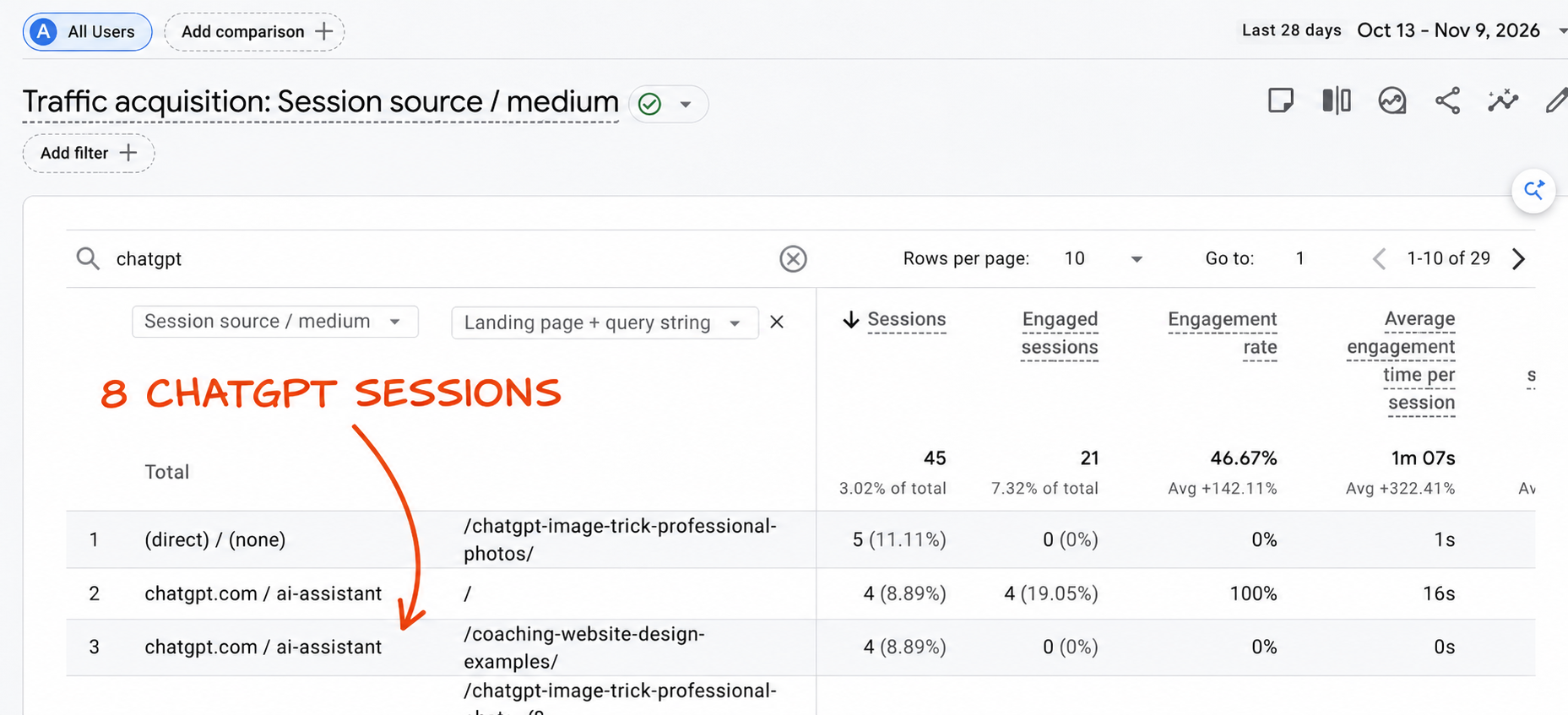
The goal is not citations for their own sake. The real value is whether AI helps the right people find, trust and contact you—even if they later reach you through Google or by typing your website address directly.
More technical info
Use your website analytics to look for visits from AI tools. Check which pages those visitors land on and whether they take a useful next step, such as joining your list or sending an enquiry.
Ask new enquirers how they found you. Someone may have seen your name in an AI answer and then searched for you later, so the original influence will not always appear as a direct referral.
You can also use:
- Google Search Console to monitor search traffic
- Bing Webmaster Tools to see supported AI citations and the sample retrieval phrases Bing calls grounding queries
- Your enquiry forms and client records to track meaningful outcomes
Bing’s AI reports can help you see which pages are being cited and which topics are associated with them. They may also suggest questions your site could answer more fully. Remember that a citation count is not a click count.
Review the pattern over several months. Improve pages that attract the right people, expand answers where a genuine gap appears and stop spending time on changes that produce no useful response.
My head exploded. What do I do now?
I realize there’s a lot to take in here. So let’s lighten it up and choose a few things you can move on now.
The name of the game is making good moves, taking steps forward and not trying to jump up the mountain every single day. Practical, fun, applicable, relevant and doable progress that we can see and measure over time is the way to go.