
Three Ways to Be Unique, Valuable, and Attractive on Your Coaching Website

Ever read your own website and thought, “Huh, this sounds like every other coach”?
You’re not imagining it. It happens constantly. The content is accurate. It’s well-written, even. And it still blends into the background.
Here’s why. Visitors skim it, nod, and move on. Nothing pulls them toward you specifically. They don’t see what makes you the coach — not just any coach.
Three things fix this.
1. Uncover Your Client-Aligned Uniqueness Factor
You don’t need to invent something new about yourself. You need to notice what’s already there, then connect it to your client’s world.
Look at your real experience. Your training. Your accomplishments. But only the ones that mean something to the client you want. Certified yoga teacher? Huge, if your clients lean spiritual. Wrote a book on a coaching approach you’ve used with dozens of clients? That’s it. Spent 30 years as an executive inside tech startups? Gold, if your ideal client is a founder trying to scale fast.
The trick: uniqueness only works when it’s tied to why it helps them. Otherwise, it’s just a fun fact about you. Nice at a dinner party. Useless on a homepage.
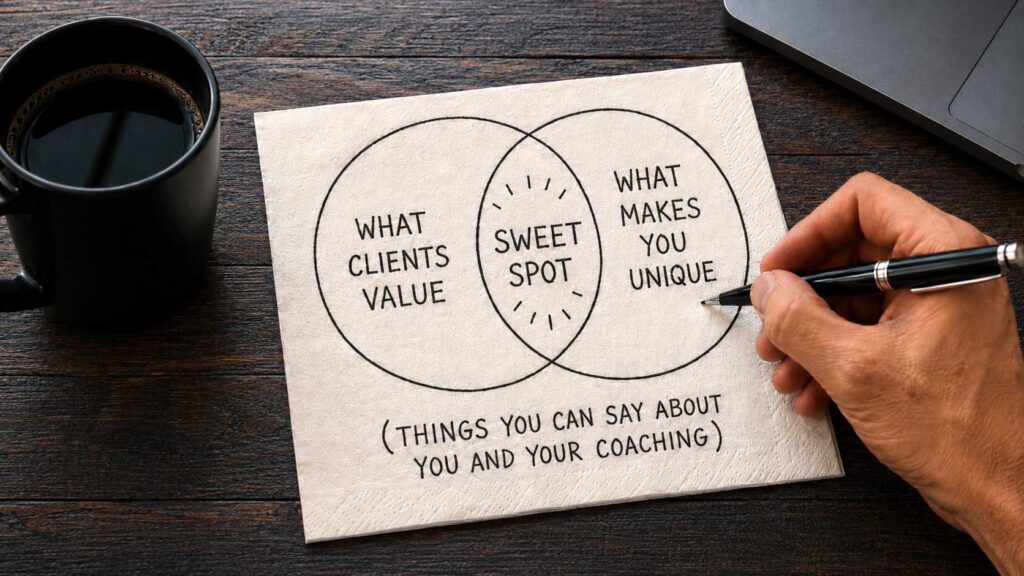
Kenn likes Venns! Here’s a diagram showing that of all the things about you and your coaching, the intersection of the subsets of “What client’s value” and “What’s unique to you” is the sweet spot :D.
More about this in this post, How to Find Your Uniqueness as a Coach. More tips and strategies to make your website attractive in my PDF book, which is handy for new sites and redesigns.
2. Choose a Brand Archetype for Impactful Visuals and Powerful Copy
Here’s a problem I see all the time. A coach sits down to write their site, or pick some photos, and depending on the day, they’re a different person. One day: energized, go-getter, let’s-do-this energy. Next day: quiet, reflective, deep-thinking energy.
Both are real you, but clash with the visitor. But when both leak into the site unfiltered, your words and images start pulling in different directions. Visitors feel the mismatch even if they can’t name it.
The car brand Jeep means adventure, and BMW means luxury. Neither one wakes up some mornings feeling like a minivan.
People trust brands that resonate. The car brand Jeep means adventure, and BMW means luxury. Neither one wakes up some mornings feeling like a minivan. You don’t need a marketing department to pull off the same trick — just pick one of the 12 Jungian brand archetypes that matches you and how you actually show up with your ideal clients. Use it as home base for your imagery, tone, and phrasing. Consistency isn’t boring. It’s what makes a brand feel real.
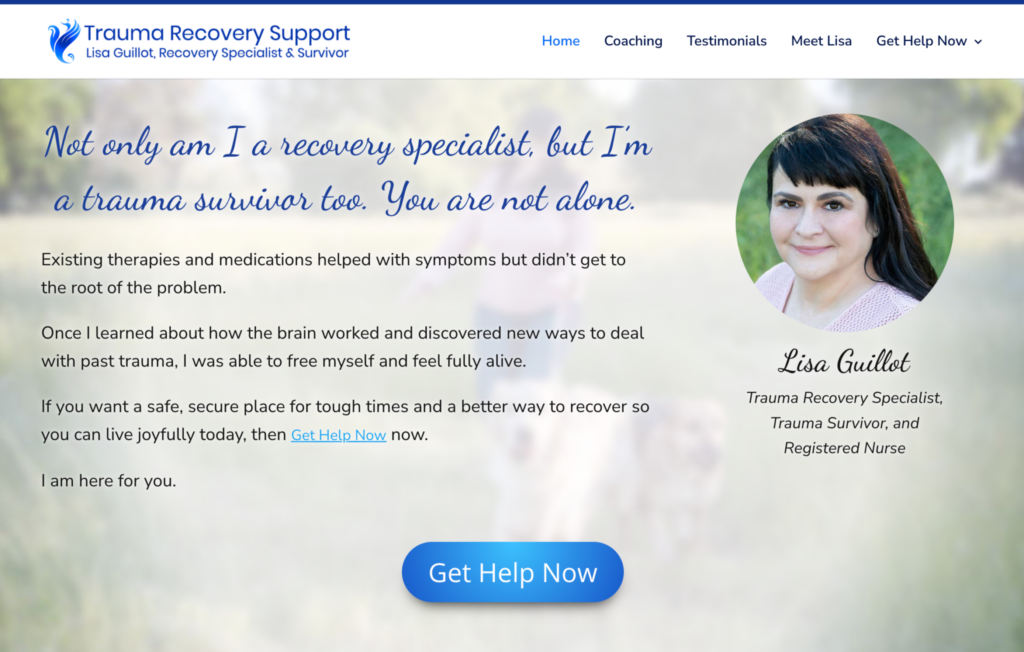
When designing Lisa’s website, we chose The Caregiver brand archetype with phrases like “I’m here for you” and “You are not alone,” and calming images of nature, blues, and greens.
For the full rundown of all 12 archetypes, see 12 Brand Archetypes to Bring Your Coaching Website to Life.
3. Get More Specific About Your Ideal Fit Client
Look at your best past clients. Or pick a new niche on purpose. Either way, get specific about who you’d be great for — and who’d get the most out of you. This is selling. This specificity gives the visitor more reasons to believe you two are a match.
Technically, sure — most coaches could help almost anyone set goals, push through obstacles, stay accountable. But clients don’t see themselves as “anyone.” They see their own mess. Their own goals. And they size you up based on whether you look like you can help with that.
Messaging Tweak Example …
Instead of “I help people set goals and stay accountable,” we get “I help you find more meaningful work and make life’s difficult changes doable even if it all feels impossible.”
That’s language fit for a life/career coach who works with professionals in their 50s facing a career change, a move, and a relationship shift — often all at once.
That’s more specific — and more valuable to a client with those challenges.
Coaches want to coach, but clients want something different. Clients want change — the results of coaching, specific to their life. The more specific you get about who and what changes for them, the more attractive your site gets to the right person.
There you have it — 3 ways to stand out in a way that draws clients to you.
- Find your uniqueness factor to show value.
- Use a brand archetype for visuals and copy.
- Get more specific about your ideal fit client.
There’s a lot more on this in my PDF book, The Coaching Website Guide — plenty of coaches have used it to grow online. Check it out here.
Question …
Which of these three hits closest to home for you right now — your uniqueness factor, your brand archetype, or getting specific about your ideal client? Drop it in the comments. I’d love to know where you’re at.
This is an essential but really scary question. I’ve been working on the answer in the back of my mind. I’m curious, flexible, adaptable, aperpetual self- reinventor, with a knack for zooming quickly into the real heart of the matter .One client said of me that she had never felt so deeply listened to in her life. Maybe my USP is my ADHD capacity to zoom in and pinpoint> None of this soundls like it’s quite it, but I ‘m keeping onto it.
Stuff like that is amazing for visitors to read in testimonials (client stories) — ESPECIALLY if there are results about that like, “From Regan’s deep listening, I found what needed to take the leap and change my career, and city over the following three months, and land an exciting job role I never thought possible.”
The trick is, the seemingly ideal clients for you are (my guess) not looking for a coach who can listen deeply. They will likely (my hunch) perk up when they know about how the big transitions you’ve been through, you’ve helped others make, and that you have a way to jump over buildings in a single bound (not exactly, but you make the impossible happen in doable steps).
;D
I gotta admit, that there’s an advantage to “not being a coach’s head” when talking about makes them unique. It’s the shoemaker’s kids issue. It’s hard to see ourselves from the outside, the forest for the trees thing.
Good discussion! Uniqueness factor, Where I have seen a difference is on the niche. For some coachees knowing the pains and struggles of the niche adds value, although as coaches we don’t advice nor recommend, knowing or being “there” somehow enables our intuition and helps to stay present and evoke awareness, yes I am preaching coaching competencies but isn’t it true? So yeah the niche makes an instant edge.
I remember Kenn was big on this and for me has worked, of course I continue taking regular coaches from different fields but the niche made a differentiator.
Coaching competencies are valuable.
Client perception of the coach, unignorable.
C’est la vie!
Really enjoyed this, Kenn. I think a lot of coaches underestimate how valuable their own experience is because it feels so familiar to them. Yet it’s often those lived experiences, combined with years of working with clients, that create a perspective no one else can replicate.
When someone has several experiences that have shaped who they are as a coach, how do you help them decide which one should take centre stage on their website without making it feel like they’re leaving an important part of themselves out?
Good question.
Some options / approaches.
1. Ask your top 3 best clients which ONE they find most appealing.
2. Use both or multiple experiences on an ABOUT ME page.
3. Also consider using 1,2 or 3 in different ways in different situations.
Here, we used three titles to emphasize unique value …
Love the car analogy. How do you work out which vehicle a coach’s best fit should be?
Claude learned my voice well, blew me away with that line. It is something I might say. Great questions Will … that’s worth a social post. On it …
In my 20+ years working with coaches and service pros, the Client‑Aligned Uniqueness Factor is the single most overlooked piece — and ironically, the one that costs people the most clients.
Most coaches talk about the coaching process or other flowery things… but not about what their ideal client actually values. When your uniqueness isn’t tied to a client’s pains, needs, or strongest desired outcomes, it becomes exactly what you said: a fun fact. Nice at a dinner party. Useless on a homepage.
Once I started aligning every message — website copy, offers, talks, even social posts — with the specific struggles and desires of my ideal clients needs – AND ESPECIALLY *WANTS* (big difference) – everything changed. Engagement went up. Conversions went up. And clients finally said, “It feels like you’re talking directly to me” and actually started reaching out to me… instead of me having to chase them. PRICELESS!
This article is a needed reminder that uniqueness only matters when it’s relevant. Shoot for clarity and message-need/want-fit.
Yeap, this => “When your uniqueness isn’t tied to a client’s pains, needs, or strongest desired outcomes, it becomes exactly what you said: a fun fact.”
I think I need to spend more time examining the overlap between my uniqueness factor & my ideal client. My biggest struggle is that I have a couple variations on my ideal client (I can’t be the only coach that enjoys working with many different types of clients, right?) Is there a way to emphasize something that might appeal to one client without alienating another?
Here’s a specific example: My ideal client is someone going through or about to embark on a difficult transition. One of my unique factors is that I left the paid workforce to be a stay at home mom for a while before returning to paid work with a different career. This might appeal to clients that are looking to reenter the paid workplace after caretaking, but I also have many clients that I enjoy that are going through other transitions. How would you handle this on a website?
So much fun, so little time ;D
I recently had to reckon with this — wanting both (1) creative, in-the-moment pursuits (2) long-term strategic, sound biz development.
I’m very curious how the following reasoning lands with you, Dianna.
I think this is where each of us needs to be clear about “what we want.” And going for one means sacrificing other options.
Consider these two …
1) If you want a business that’s scalable, earns a lot, and that’s more important than the joy of being part of folks’ tough transitions, then narrowing to a single focus with a killer offer, and building systems is the move.
2) If gradual joy in the variety of ways to grow your business- one-on-ones, teaching opportunities, learning new technology, and creative work- then great, pick aspects of “you” to grow. Lots of amazing fulfillment in simply helping others with coaching skills, and getting paid along the way.
Now, this doesn’t mean we can’t try to be smart, get clever about how to do versions of both.
Or make moves that hit on both fronts — systems, multiple niches, get better at selling.
Interestingly, if one chooses to be great at piano and forgoes learning the drums, down the line when the keyboard skills are so high, I suspect a shift to beating sticks will be learned faster and easier due to better knowledge of music.
In that way, choose a short work adventure, say a few months, to narrow in on one niche (if you end up wanting to test focus) for the time being.
And again, nothing bad about grabbing low-hanging fruit, even if not in the niche, for immediate work, income, and enjoyment of coaching.
That does make a lot of sense to me…I like framing it as a short work adventure. It keeps me from getting too perfectionist & releases a bit of stress around my focus
Short, fun, productive work adventure. 😀
I’d say all 3 to be honest. The 1st one is where I’ve spent the most time. Kind of a ‘dig deep enough to pull out the thing that touches everyone’ approach. I’m a both/and guy. Army guy girl dad. Easter Coaster West Coast vibe. Poor kid Rich school. You get it. So I lead with that. Over time, I’ve spent more time on 2 and 3.
From New York, but folks often think I’m a surfer west coaster too.
Is it possible for a person’s brand archetype to change over time? I just changed the entire vibe of my brand.
Possible, I suppose so. I think just using one archetype to help keep things glued together nicely is a big deal for messy sites (most of them).